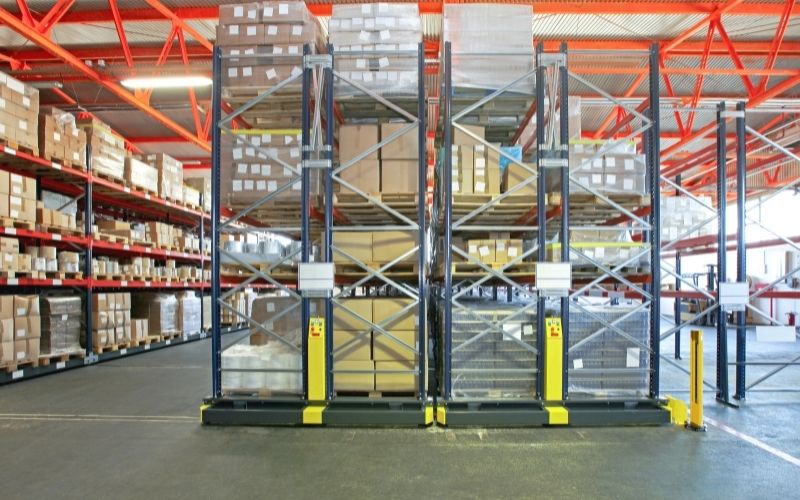
Many warehouse procedures are becoming more efficient as technology augments or, in some cases, automates repetitive, manual tasks, allowing employees to focus on more complicated jobs. Warehouse automation can take numerous forms, including equipment and robots that assist humans with inventory procedures from the time it enters the warehouse to the time it leaves. Warehouse automation systems can help warehouses enhance productivity and accuracy while also lowering labor expenses and increasing safety.
That isn't to say that machines are taking over or stealing jobs from people. Rather, corporations are leveraging machines' accuracy and capacity to operate continuously for long periods of time without becoming fatigued to make warehouse activities safer and more efficient. Humans are still present in some warehouse automation solutions, which encompass everything from unloading trailers to fulfilling orders. Let's look at the main advantages warehouses obtain from deploying automation technology.
Benefits Warehouse Automation
Warehouse automation is used for a variety of purposes, one of which is to increase efficiency. You will free up staff to conduct more difficult work whenever you can take duties that a person would ordinarily do and have them completed automatically by a computer system or machine. A sequence of conveyor belts or other similar systems, for example, can automate the movement of parts or packages.
Another advantage of automation is that it improves the precision of the job done at the facility. This is frequently accomplished by placing barcodes on each item being kept or used in the warehouse. This manner, teams can simply scan a barcode to identify where it should be stored or where it should be sent.
Different types of Warehouse Automation Technologies
There are many kinds of warehouse automation, as there are many kinds of warehouse equipment and technology that are available. Warehouse automation is designed to reduce manual labor and accelerate processes starting with receiving and shipping.
The technology of warehouse automation includes:
- Goods-to-Person (GTP): Goods-to-person fulfillment is among the most well-known methods of increasing efficiency and decreasing congestion. This includes conveyors, carousels, and Vertical lift system. If properly used, GTP systems can double or triple the speed of picking warehouses.
- Automatic Storage and Retrieval Systems (AS/RS): AS/RS are an aspect of GTP fulfillment technology which includes automated systems and devices like material-carrying vehicle and trolley shuttles and mini-loaders that store and recover products or materials. Warehouse applications that are large in volume and have limited space tend to use AS/RS systems.
- Autonomous Guided Vehicles (AGVs): This type of mechanized automation comes with limited onboard computing power. They use wires, magnetic strips, or sensors to guide an undefined path through the warehouse. AGVs are only suitable for vast, simple warehouses built with this layout of navigation. Warehouses that are complex and have lots of traffic from humans and space limitations aren't ideal for AGVs.
- Automated Mobile Robots (AMRs): More adaptable than AGVs. AMRs utilize GPS systems to design efficient routes to a particular warehouse. They utilize sophisticated laser systems to identify obstructions, meaning that AMRs are able to navigate in safe environments that have a lot of people. They are simple to program with routes , and simple to set up quickly.
- Pick-to-Light and Put to Light System: These systems use barcode scanners that are mobile and linked to LEDs that are digitally controlled to instruct warehouse pickers to where to put or pick up the items they want. They are able to drastically reduce the time spent walking and searching and also human error in high-volume situations.
- Voice Tasking and Picking: The implementation of voice-directed warehouse processes which is also referred to as pick-by-voice that utilizes speech recognition software as well as mobile headsets. The system can create optimized picking paths that direct warehouse workers on where to pick or store a product. This eliminates the need for handheld devices such as scanners using radio frequency, which means that workers can focus on their work while ensuring safety and efficiency.
- Automated Sortation System: Sortation refers to the method of identifying objects on conveyor systems and redirecting them to warehouses with barcode scanners, RFID and sensors. Organizations use automated sortation technology for delivery of their orders for receiving packaging, picking, and shipping.