For application development, various programming languages are utilised around the world. Each has its own set of characteristics and advantages. Python is one of the most popular programming languages today. Do you know what Python is useful for? Python has emerged as a few languages relevant now and has a bright future. Python's reach has grown with each passing day since it was founded in 1991 by a developer named Guido Van Rossum, with major corporations utilising it for their application development efforts.
While this speaks a lot about it, Python has drawbacks that lead many application developers to favour alternative languages. We hope that by exposing the advantages of Python programming, you will decide whether or not to utilise it for your next project and can get python homework help. In this blog, We will discuss the advantages of Python.
A Few Popular Applications Of Python
Let's take a quick look at some Python applications before we get to the meat of this topic.
Python is an advanced programming language that is used to create high-level applications such as:
- Web Server Programming: Python frameworks like Django and Flask allow developers to do server-side programming.
- Prototyping: Python allows developers to generate prototypes to demonstrate to clients quickly.
- Game development: Through libraries like PyGame, it is frequently used to construct games, including GUIs.
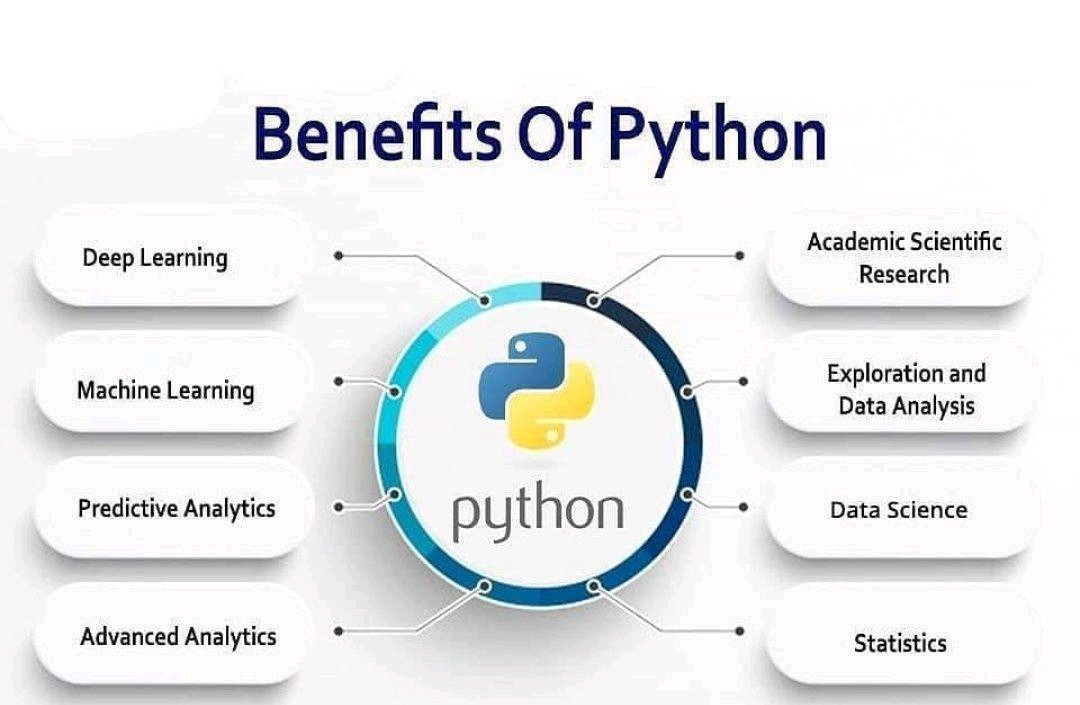
- Data science and machine learning: Python is the greatest and most widely used machine learning and data science language. Python helps a lot with application development in the field of data science because it has a large community and a wide selection of libraries. It includes libraries for data processing, data visualisation, data cleaning, and various other functions.
Now that we've established the concept let's look at the positive and negative aspects of Python. We will discuss the many advantages of Python.
Key Advantages of using Python
There's a reason why Python is so popular among programmers. It has a few unique characteristics that make programming a whole lot easier. Let's have a look at some of the features that make Python so useful:
Easy to read and learn
Python is an easy-to-read and-learn programming language. It doesn't have the same complicated syntax as other high-level languages like C or C++. Python's simplicity allows you to think more clearly and concentrate on logic construction.
Reduces Maintenance Cost
Python's simplicity makes application maintenance easier and, as a result, lowers expenses, which is a significant benefit.
Avoid the Harms from Software Bugs
Python does not allow a defect in the code to cause a segmentation fault in the application. As a result, it is regarded as a preferred language.
Wide Applicability
Another important quality of this language is its broad applicability. It is widely used by engineers, scientists, and mathematicians.
Memory Management
Python distinguishes itself from other programming languages by having a large library with memory management features. It has a private heap that contains all Python objects and data structures and a built-in memory manager to keep this private heap in good shape.
Straightforward and Speedy
The Python community provides users with quick and practical support and rapid code adaptation. Some experts have dub Python the "ready-to-run language" since it just requires simple code to run. Python is a lot easier to work with when improving and testing code.
Asynchronous Coding
Asynchronous coding uses a single event loop to finish a job in brief intervals. Python is a fantastic language for building asynchronous programmes since it is simple to write and maintain. It doesn't necessitate any complicated research debates, deadlocks, or other complications.
Integration with Other Languages
Python is the finest language for integrating enterprise applications (EAI). It simplifies online application development, CORBA or COM component invocation, and direct calls to and from Java/C++/C. It also includes elements for dependable process control and the application of internet data types and protocols. Python also aids users in processing markup languages like XL, runs on advanced operating systems using the same byte code, and can be used as a scripting language.
Conclusion
It is one of the most widely used programming languages. The advantages of Python aside, it is still one of the most popular and trusted languages for building desktop and web server-side applications. I would recommend it for AI and machine learning applications, but not for mobile or GUI development. Considering its performance, we can conclude that Python has more advantages than disadvantages. Python is one of the best choices for coding if a skilled developer uses it.