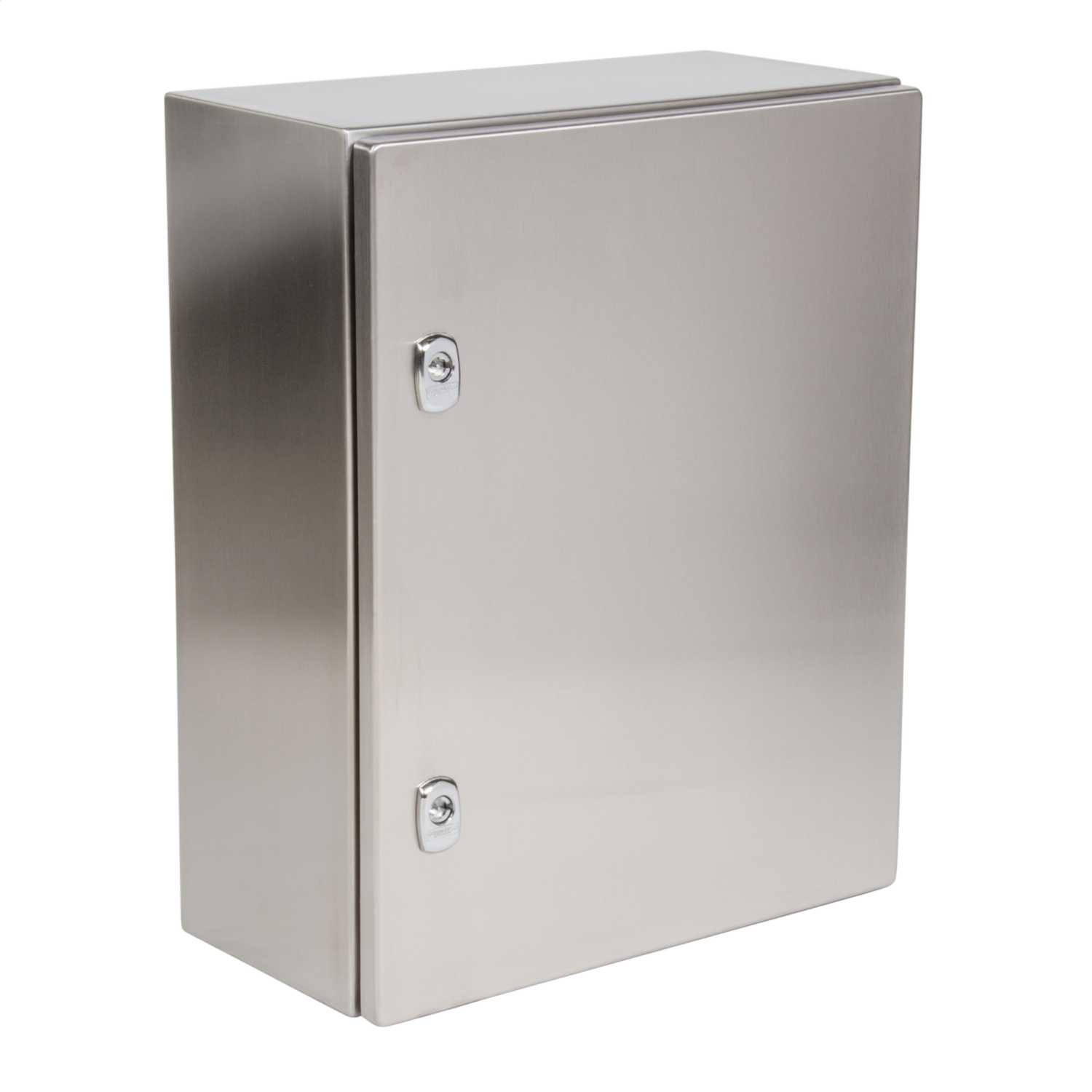
Industrial enclosures are utilised to house electric and electronic devices, equipment, and components. They help to protect personnel from accidental injury when handling these in operation and prevent the ingress of contaminants like water and dust.
Whether it is a unit for data processing, control box or junction box, or any other device, the choice of the industrial enclosure will be a determining factor of the safety and performance of a machine.
Numerous factors impact the process of deciding on industrial enclosures. Looking at all of them all at once is overwhelming and can cause mistakes. So, one must consider each factor, one by one. Some of the common factors include the enclosure’s size, the enclosure’s material, and the requirement for custom enclosure labelling and cut-outs.
Selection of size
Following are the best practices to choose from the many sizes in which enclosures are available:
- Keep a device schematic or panel layout while selecting the size of enclosure and bill of materials. Note the size of every component and examine where each must be positioned.
- Ensure that one leaves adequate room for running wires inside the enclosure.
- Wherever possible, note the space in which the enclosure will be mounted. Ensure that there is room to shut and open any swinging door of the enclosure.
- Identify the source of any heat build-up within the enclosure and calculate the quantum of space required for ventilation structures.
- It is wise to select an enclosure with additional space included to accommodate any assembly. Only with adequate space can personnel manipulate the device components stored in the enclosure.
Space is a valuable concern for device designers; it is vital to balance device operability, safety, and space conservation.
Selection of material
This has a significant bearing on the performance of one’s enclosure. Selecting the ideal material will help protect the device from the elements and its sensitive components; hence, choosing a material with the required properties is vital.
Ask the following questions while selecting materials:
- Will the enclosure require customised cut-outs meant for external features like antennas or conduits? Polycarbonate is the material ideal for cut-outs.
- Will the device be placed outdoors or indoors, and what kind of environment will it be exposed to? Stainless steel and Polycarbonate enclosures are highly reputed for their toughness, even in the outdoors. Both are also suitable for anti-corrosive properties.
- Which material choice determines aesthetic concerns? Stainless steel and Aluminium enclosures are famous for their elegant looks.
Cooling and ventilation
Several industrial pieces of equipment generate heat, so their enclosures may be required to be ventilated to manage and mitigate this heat. Another concern is a build-up of moisture for which there is a need for devices like enclosure vents.
Metallic enclosures are susceptible to heat generation in comparison to plastic enclosures. But the equipment that does not generate much heat might not need active ventilation.
Components generating much heat typically require devices like blower fans for helping in the dissipation of heat from the enclosure.
Ratings
The main ratings for electric enclosures are IP ratings (worldwide) and NEMA ratings (North America). NEMA ratings use a number and alphabet system.
IP ratings rate the power of protection of an enclosure against solid and liquid ingress. IP rating uses two numbers for rating the protective capacities of enclosures. The first number rates protection from dust on a scale of 1 to 6, and the second number rates protection against liquids on a scale of 1 to 8.
Digital printing and cut-outs
Several enclosures require cut-out areas for accommodating antennas, cables, and other critical elements. Device labelling can also be vital for industrial enclosures since several industrial devices need sophisticated diagrams and labelling for the safety of operations.
In sum, these are some of the factors which determine the choice of industrial enclosure.