Running is anti-social. And not to say that runners are anti-social. Just the activity itself. It requires little equipment, sometimes not even shoes. And creates competitiveness without the need for competitors. Besting oneself is often times all a runner needs.
But if you are going to compete against yourself, you need a record of your performance. And creating that record requires a device that tracks the metrics you want to capture and improve. Such technology already exists with smartwatches, smartphones, and running applications.
But eventually, you will accumulate so much data that it is too large to process. Or you want to shadow compete against other users on your running platform. If a runner wants to transition from a sport of one to a group of some there is legwork. A logical first step is a visit to the interwebs to tap into social networks to uncover a running buddy and their data. Although, it would be easier if a running partner and their statistics just found you.
Researchers are exploring whether strategically-placed and data-dense interactive displays can create new social relationships, outside of traditional social apparatuses. Electronic displays positioned near running trails attract users with creative visualizations and a rotating series of questions. “Do younger people run faster?” and “Does weight influence speed?” are two stimuli engineered to excite passerby.
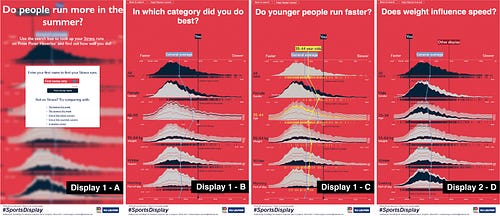
A display showing 4 vertically-oriented display screens. At the top of the screens are individual questions and beneath the questions are graphic visualizations displaying running data.
Imagine, as a runner, you come across an interactive display that asks “In which category do you fit best”? You glance at your Garmin fitness watch and realize you have time for a break to answer that question. As you navigate through the screens, you see a familiar stranger and invite them to explore the display with you. This is an interaction that could happen when running displays are situated along a running trail. An interactive visualization like Sankey Diagram, full of relevant and insightful data, encourages engagement and smooths the transition from stranger to friend to running buddy.
There isn’t anything that prevents fellow runners from going beyond the polite nod of acknowledgment. Runners can exude a “Do Not Disturb” attitude with their earbuds and plodding focus. Frequently, unbeknownst to most, runners don’t mind distractions to break the monotonous heel-toe rhythm. The easiest diversion is a running partner but varying schedules, different paces, responsibilities, and location can impede the formation of new running relationships. These digital screens and their queries are the perfect enticements to convince a runner to interrupt their exercise.
For this experiment, the application is populated with data from Strava, a running and cycling application that tracks exercise. The information includes demographics such as first name, date, time, age, weight, gender, and route. Curious participants can search for themselves or peruse the pre-loaded data to receive graphical results concerning the performance of other runners. The visualizations also encourage spontaneous conversations among unrelated users which can lead to richer social interactions and interconnected communities.
These monitors also help to make big data approachable. Imagine the number of people who go for a run and log their progress into an app such as Strava. Strava collects data about their activities but there are other datasets that can contribute to the richness of the visualization. Other statistics to consider are temperature, humidity, pollen counts, sunrise and sunset times to give greater depth to the data displays.
Interactive, data-rich monitors are a solution to create new in-person interactions based on shared interests. And lest you think it won’t work, consider this. If you’ve ever seen a provocative outdoor sculpture, motion-controlled water feature, or even a dog park, you’ve seen the proof of this thesis. In these situations, participants connect with one another due to proximity and natural curiosity. Thus, if compelling content is placed within an environment using an appropriate medium, social interactions can organically begin and transition anti-social running into a social network.
Image Source: People photo created by jcomp - www.freepik.com