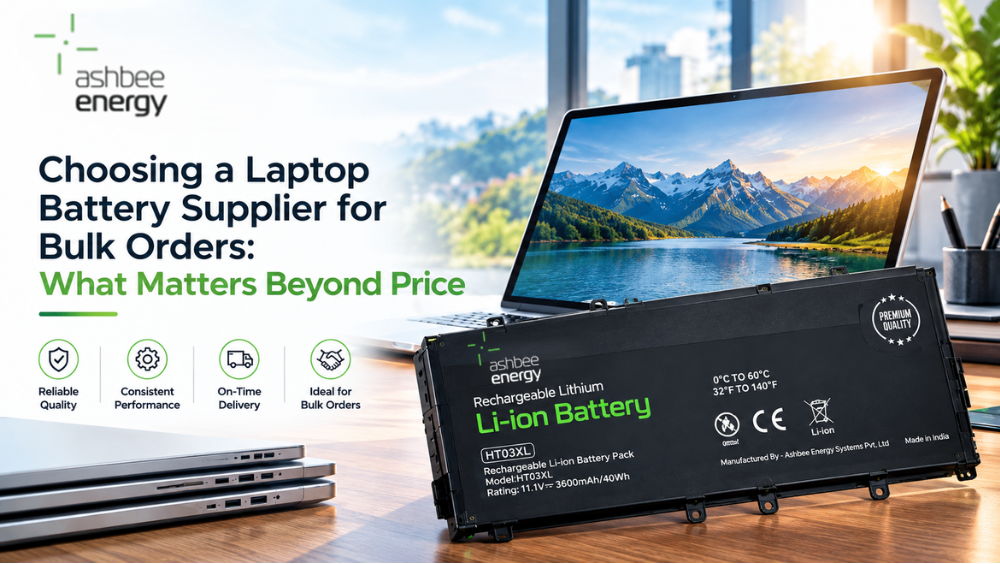
Laptop batteries are bought in bulk by many kinds of businesses. Distributors, refurbishes and re-commerce platforms buy them. So do service networks and laptop brands. Each buy for a different reason, but they all need the same thing from a laptop battery supplier: every battery in the order should work as well as the sample they tested.
When a lithium ion laptop battery fails after it reaches the customer, the cost is much more than the price of the battery. There is the replacement unit, the technician's time, the shipping and a customer who now trusts the seller a little less.
That is why buying at volume is mostly a question of consistency. One good sample tells you very little. What matters is whether the hundredth battery works like the first.
A Laptop Battery Has to Match the Laptop, Not Just Fit It
A replacement lithium ion laptop battery has to do more than fit the laptop. Its battery management system (BMS) has to work correctly with that laptop's charging circuit. It also has to report the battery level to the laptop correctly. You only notice this when it goes wrong. The laptop may show the wrong battery percentage or it may shut down at 30% even though the cells inside are fine.
What Happens When a Battery Does Not Match the Laptop?
A replacement battery built with perfectly good cells can still misbehave. If the BMS communication protocol doesn't match what the laptop's firmware expects, the symptoms show up fast: inaccurate charge readings, early shutdowns, or charging that stops at 80% with no error message anywhere. It usually means the battery was never tested with that model, so the laptop is reacting to information it doesn't trust.
For a repair business, each of these problems arrives as a customer complaint, usually within the first few weeks. The cheapest way to prevent them is to check that each battery is matched to the specific laptop model and not just to the connector and the size.
What to Check Before Placing a Bulk Order?
Cell quality. Ask what grade of cells is used. A-grade cells meet the full specification of the cell maker. Consistent cells are what make one batch behave the same as the next.
BIS certification. In India, lithium-ion batteries for laptops fall under the BIS Compulsory Registration Scheme. Ask for a valid BIS certificate for the product you are buying.
Safety protection. Protection against overcharging, short circuits and overheating should come as standard.
Model range. A supplier that covers many laptop models makes buying simpler, because more of your needs are met by one source.
Warranty. The warranty from your supplier decides the warranty you can give your own customers. Ask for the terms in writing.
Returns. Ask what happens when a battery is faulty: who you contact, what they need from you and how quickly a replacement reaches you.
Custom requirements. Some orders need a specific configuration. Ask whether the supplier handles customization in-house or depends on another company for it.
Price per unit still matters. But the number that matters most is the cost of each battery that stays with the customer.
Working to a Specification
Companies that sell laptops under their own name or support them through large service networks, usually work to a detailed specification. The battery must match the model, meet safety requirements and stay consistent across every batch.
Supplying to a specification like these needs three things from a battery partner: control over customization, a clear compliance record and consistent quality at volume. These are the points to discuss early with any supplier you are considering for long-term supply.
How Ashbee Energy Supplies Laptop Batteries
Ashbee Energy supplies oem laptop batteries replacement in bulk to distributors, refurbishers, repair businesses and re-commerce platforms. Our range covers over 70 laptop models.
Every laptop battery replacement uses A-grade cells and is BIS certified. It also has built-in protection against overcharging, short circuits and overheating. Each battery comes with a 12-month warranty. Our returns process is simple, so a faulty unit is replaced quickly and your customer is looked after.
Customization is handled in-house by our own team. This means we can work to a specification, whether it comes from a distributor, a service network or a laptop brand.
For anyone ordering laptop batteries at volume, IT departments and repair businesses especially, the BMS compatibility conversation is worth having before the order goes in. Fixing the problem after a batch of faulty replacements arrives always costs more than getting it right at the start.
FAQs
Q. What should I look for in a laptop battery supplier?
Ans. Look for model-specific compatibility, A-grade cells and BIS certification. Built-in safety protection, a clear warranty and simple returns process also matter. For large or long-term orders, also ask about in-house customization.
Q. What warranty do Ashbee Energy laptop batteries have?
Ans. Every battery has a 12-month warranty and faulty units are handled through a simple returns process.
Q. Can Ashbee Energy supply batteries to a specific requirement?
Ans. Yes. Customization is handled in-house. Share the laptop model, the configuration you need and the order volume. Our team will confirm what is possible.
Q. How many laptop models does Ashbee Energy cover?
Ans. Our range currently covers 70 laptop models. If you need a model that is not on the list, contact our team at sales-energy@ashbee.com.
Q. Why does a laptop show the wrong charge level after a battery replacement?
Ans. This usually happens when the BMS in the new battery is not communicating correctly with the laptop. The cells may be fine, but the laptop cannot read the battery correctly. Matching each battery to the specific laptop model prevents this.
Q. How should a repair business handle old batteries?
Ans. It should go to a certified e-waste or battery recycling facility, Lithium-ion cells aren't safe in regular waste. A swollen or damaged battery should be stored separately, away from heat, until it is collected.
Q. Can a mismatched BMS damage the laptop?
Indirectly, yes. Irregular charging behavior stresses the charging circuit over time, and a swollen cell can press against the trackpad or screen from inside the chassis. A swollen battery should always be replaced immediately.