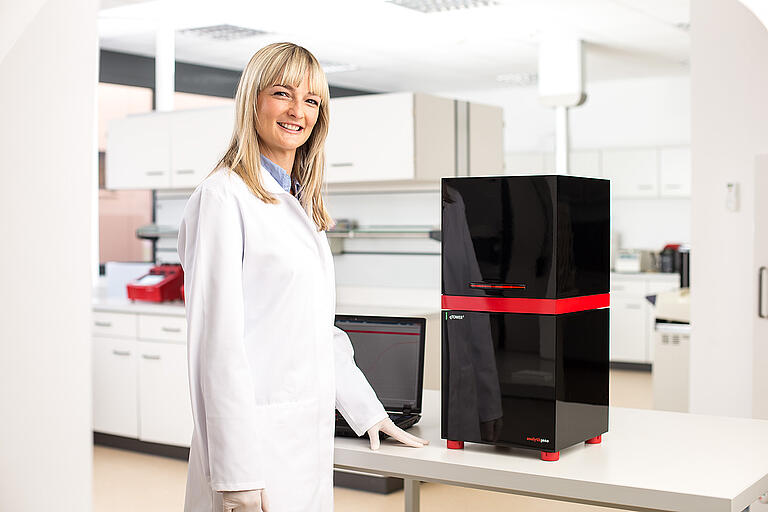
The Real-Time PCR technique is used to monitor the progress of DNA amplification during the Polymerase Chain Reaction or PCR in real-time. The reaction rate in this reaction can be determined at a fixed point during the exponential amplification or measured continuously. Unlike the ordinary preparative Polymerase Chain Reaction, RT-PCR allows the success of multiple PCR reactions to be determined automatically after only a few cycles. In RT PCR machines there is no separate analysis of each reaction which prevents the issue of "false negatives."
What is RT PCR?
As we already know RT PCR is a technique used to monitor the progress of a PCR reaction in real-time. In the Real-Time PCR machine, a relatively small amount of PCR product (DNA, cDNA, or RNA) can be quantified at the same time and the procedure is based on the detection of the fluorescence produced by a reporter molecule which enhances as the reaction progresses. The real-time PCR process is also known as the quantitative polymerase chain reaction (qPCR), which is a laboratory-based process of molecular biology based on the polymerase chain reaction (PCR).
The principle behind RT PCR
RT-PCR allows exponential amplification of DNA sequences with a pair of primers extended by DNA Polymerase that is complementary to the sequence of interest. After the extraction, the copies so formed are known as amplicons.
Then they are re-amplified with the same primers leading thus to exponential amplification of the DNA molecules. However, after the amplification, gel electrophoresis is used to analyze the amplified PCR products and this makes conventional PCR time-consuming. Also, take into consideration that the term “real-time” denotes that it can monitor the progress of the amplification when the process is going on in contrast to the conventional PCR method.
RT PCR: sustainable and cost-effective
Just like how the principle of amplification is used in PCR, in real-time PCR it is done in real-time. In its entire sum and substance, the reaction is placed into a real-time PCR machine that watches the reaction occur with a camera or detector.
The amplification is done in three steps. The first one is Denaturation. In this process, high-temperature incubation is used to “melt” double-stranded DNA into single strands and loosen secondary structure in single-stranded DNA. Always keep in mind that the time for denaturation can be increased if template GC content is high.
The second process is Annealing. This happens when the complementary sequences get the chance to hybridize, so an appropriate temperature is used that is based on the calculated melting temperature of the primers.
The last process is an extension that is done at 70-73°C when the primer extension occurs at rates of up to 100 bases per second as the DNA polymerase is optimal.
Conclusion
The RT PCR machine is an embodiment of powerful advancements in microbial diagnostics. In parasitic as well as viral detection, quantification and the suitability of this process is beyond doubt. When sensitive and rapid diagnostic assays are required, the RT PCR principle can replace culture techniques.